
In the 10 years I have been involved with our school district, including 2 years on the Committee and 4 on a subcommittee, I tried to bring my own perspective and expertise to the table. I employ 60+ people in my business, and have hired hundreds over the years. Our employees are critical to the success of my business, and watching the health of the relationship between employer and employee is one of the most important dynamics to watch. For 3 straight years, my employees have named us one of Rhode Island’s Best Places to Work.
This matters in the district, too. I advised on this while on the Accountability Subcommittee, and I spoke directly to this as the Chair of the Committee last year. For sake of argument, we can call it morale, but if that is the only word you hear describing it, rest assured that person doesn’t have a lot of experience with organizational behavior. A key indicator of “morale” is turnover. An organization will have a natural attrition; people move, retire, or simply take better jobs elsewhere. With 500 or so employees in the district, and being in the northeast, turnover above 6.8% might indicate a problem. In other words, anything over about 34 separations each year would be notable.
There were many anecdotes about “morale” over the last few years. When in a full policy making role, I knew this needed attention, so I began watching South Kingstown’s turnover rate. It is more complicated than this one metric, but the rate was always right in the expected range, suggesting a normal “morale”. I say it is complicated, because other factors might impact turnover. For example, if an employer systematically overpays its workforce, they become trapped, and might have to stay employed despite being unhappy. In other words, high compensation and benefit packages can mask problems with the employer – employee relationship.
On describing this to other Committee members last year, there was confusion, possibly deliberate, interpreting my remarks as meaning “morale is great” in South Kingstown. Again, this showed a lack of understanding of the complicated nature of organizational behavior. Larger than that, it shows a default to political posturing, rather than simply listening to someone that might have broader experience in a subject area.
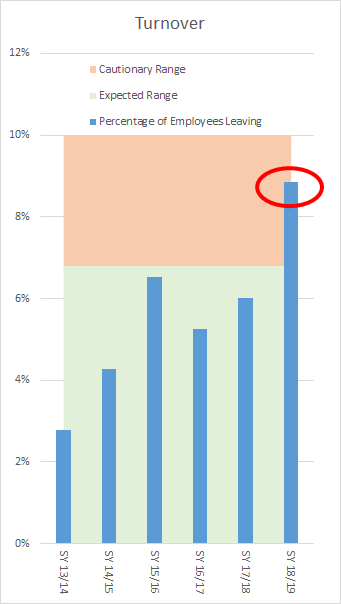
This chart shows the last 6 years of turnover. Numbers were compiled from every personnel action summary of the School Committee meetings since 2014. We hear that ”morale” was terrible under the prior Committee and Superintendent. And yet, for all of those years, turnover remained in an expected range. It was not until this year, under entirely new leadership promising to fix “morale”, that we see a turnover spike like none in the last several years.
Calendar year to date, nearly 9% of the district workforce has left voluntarily. In total, 43 people have chosen to move on. Many of them were administrators, but even among the teacher ranks, we are seeing the highest number of departures in recent years, with 20 choosing to leave their employment since the beginning of the year. The previous high was 19 and that was from a larger total pool of employees.
We see some trying to brush it off as an exodus of those that preferred the old leadership style. It might be explained by the fact that generous compensation packages have trapped people for too long, i.e. Golden Handcuffs. It might even correct itself once new leadership settles in. At least with the last, we would only have suffered two years of rudderless chaos.
What must be considered, though, is that we are seeing the greatest voluntary departure in recent years. If “morale” had been fixed by the new leadership, we should expect a different result. And if you believe that “morale” is a key component of organizational success, which you should, than South Kingstown may be in for a tough year.
 9guest1111
 Belinda Matson
 DORALD BEASLEY
 brucewaidler
 Community Comment
 Roland
 debbergner
 Jason Ralph
 Dr. Joslin B. Leasca, MSN, DNP, FNP, CNL, CNE
 Melanie Reppucci
 nicolemulanaphy
 petruccialex
 rickbeaule
 Greg Sweet
 SK Spotlight
 tmsrebels
 South Kingstown Spotlight